Schmidt Hammer Test Services (Non-Destructive Concrete Testing)
Atlas Engineering and Technology Group provides professional Schmidt Hammer testing services across Sydney and New South Wales. As a fast, non-destructive method for estimating the surface hardness and indicative compressive strength of in-situ concrete, the Schmidt Hammer test is widely used for condition assessments, structural investigations, and quality control on existing and newly placed concrete.
What Is a Schmidt Hammer Test?
The Schmidt Hammer test, also known as the rebound hammer test, is a non-destructive testing (NDT) method that measures the surface hardness of hardened concrete by recording the rebound of a spring-loaded hammer impacting the concrete surface. The rebound number is correlated to the estimated compressive strength of the concrete using manufacturer-supplied or project-specific correlation curves.
Testing is conducted in accordance with AS 1012.23 and the international standard ASTM C805. The method is valued for its speed, portability, and ability to test large surface areas without damaging the structure.
How the Test Works
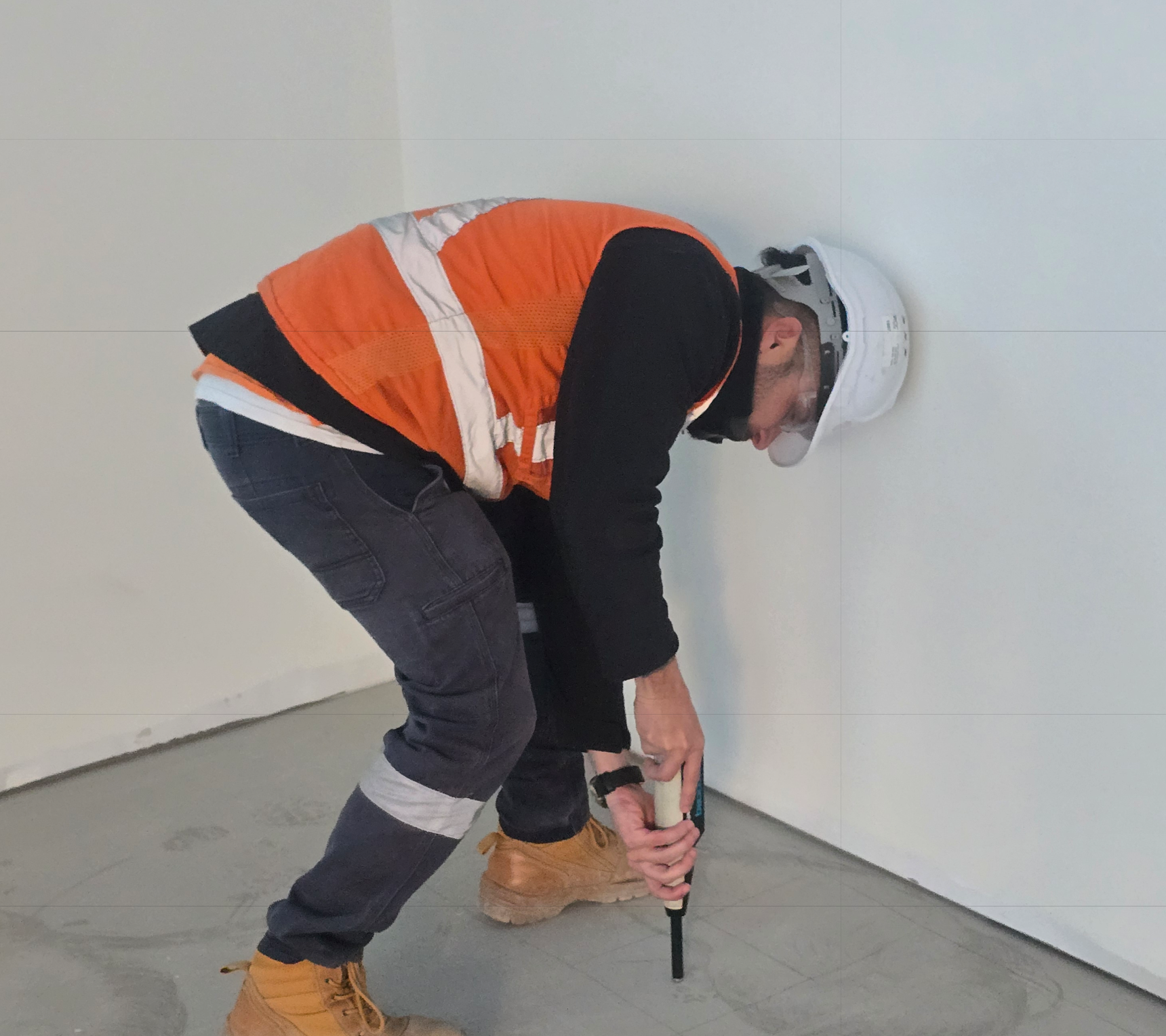
- The Schmidt Hammer is held perpendicular (or at a specified angle) to the concrete surface.
- The spring-loaded plunger is pressed firmly against the surface until the hammer fires.
- The rebound distance of the hammer mass is recorded as the rebound number (R).
- A minimum of 9–12 readings are taken per test area, with outliers discarded per the standard.
- The average rebound number is converted to an indicative compressive strength using a correlation chart.
Note: The Schmidt Hammer provides an indicative estimate of compressive strength only. Results are influenced by surface carbonation, moisture content, aggregate type, and concrete age. Where confirmed strength values are required, core extraction and laboratory testing per AS 1012.14 is recommended.
Applications
The Schmidt Hammer test is suited to a wide range of structural assessment and quality control scenarios, including:
- Condition assessments of existing structures — bridges, car parks, retaining walls, and buildings
- Pre-demolition or pre-renovation investigations to estimate existing concrete strength
- Verification of in-situ concrete strength where cylinder results are unavailable or disputed
- Large-area uniformity mapping to identify zones of weaker or deteriorated concrete
- Formwork and propping removal assessments for early-age concrete
- Post-fire assessments to evaluate residual concrete integrity
- Quality control on precast elements and tilt-up panels
Our Schmidt Hammer Testing Services
Atlas provides Schmidt Hammer testing as a standalone service or integrated within broader structural or geotechnical investigation programs. Our services include:
- On-site rebound hammer testing: performed across Sydney and greater NSW by experienced technicians
- Grid-based surface mapping: systematic testing across large or complex structures to identify variation
- Combined NDT programs: Schmidt Hammer testing paired with cover meter surveys, carbonation testing, or half-cell potential measurements
- Structural condition reports: detailed findings with rebound number data, strength estimates, and recommendations
- Core correlation programs: Schmidt Hammer results calibrated against extracted core strengths for improved accuracy
Rebound Number Interpretation
The following table provides a general guide to interpreting Schmidt Hammer rebound numbers for horizontally tested, ordinary Portland cement concrete. Values are indicative only and should be interpreted in context.
Rebound Number (R)Indicative Concrete QualityEstimated Compressive Strength< 20Poor / Potentially Deteriorated< 15 MPa20 – 30Fair15 – 25 MPa30 – 40Good25 – 40 MPa40 – 50Very Good40 – 55 MPa> 50Excellent / High Strength> 55 MPaNote: These ranges are approximate and based on standard correlation curves for horizontal testing. Vertical or overhead testing requires angle correction factors. Actual strength estimates must be supported by correlation data appropriate to the specific concrete mix.
Limitations of the Schmidt Hammer Test
While the Schmidt Hammer is a valuable and widely accepted tool, the following limitations should be understood when interpreting results:
- Surface carbonation can increase rebound numbers, leading to overestimation of strength in older structures
- Wet or saturated concrete typically yields lower rebound numbers than equivalent dry concrete
- Near-surface aggregate directly beneath the impact point can skew individual readings
- Concrete age and mix design affect the strength–rebound relationship and require mix-specific correlation
- Results represent surface hardness only and do not reflect internal defects, delamination, or deep deterioration
Where results indicate potential structural concerns, Atlas recommends follow-up investigation using complementary NDT methods or intrusive testing such as core extraction.
Applicable Standards
- AS 1012.23: Methods of testing concrete: Rebound number of hardened concrete
- ASTM C805: Standard Test Method for Rebound Number of Hardened Concrete
- AS 3600: Concrete structures
- EN 12504-2: Testing concrete in structures: Non-destructive testing (rebound number)
Who We Work With
Our Schmidt Hammer testing services are engaged by a broad range of clients across Sydney and NSW, including:
- Structural and civil engineers conducting condition assessments
- Building owners and facility managers requiring structural appraisals
- Developers and contractors verifying in-situ concrete strength
- Insurance assessors and loss adjusters following structural incidents
- Local councils and government infrastructure teams
- Independent certifiers and principal contractors
Request Schmidt Hammer Testing
To arrange on-site Schmidt Hammer testing or to discuss your non-destructive concrete assessment requirements, contact the Atlas Engineering and Technology Group testing team. We offer prompt mobilisation across the Sydney metropolitan area and broader NSW, with clear, concise reporting suitable for engineers, certifiers, and building owners.