Concrete Slump Test Services
Atlas Engineering and Technology Group provides professional concrete slump testing services across Sydney and New South Wales. As part of our comprehensive materials testing program, slump tests are a fast, reliable method for assessing the workability of fresh concrete, both on-site and in our laboratory, to ensure every mix meets project specifications before placement.
What Is a Slump Test?
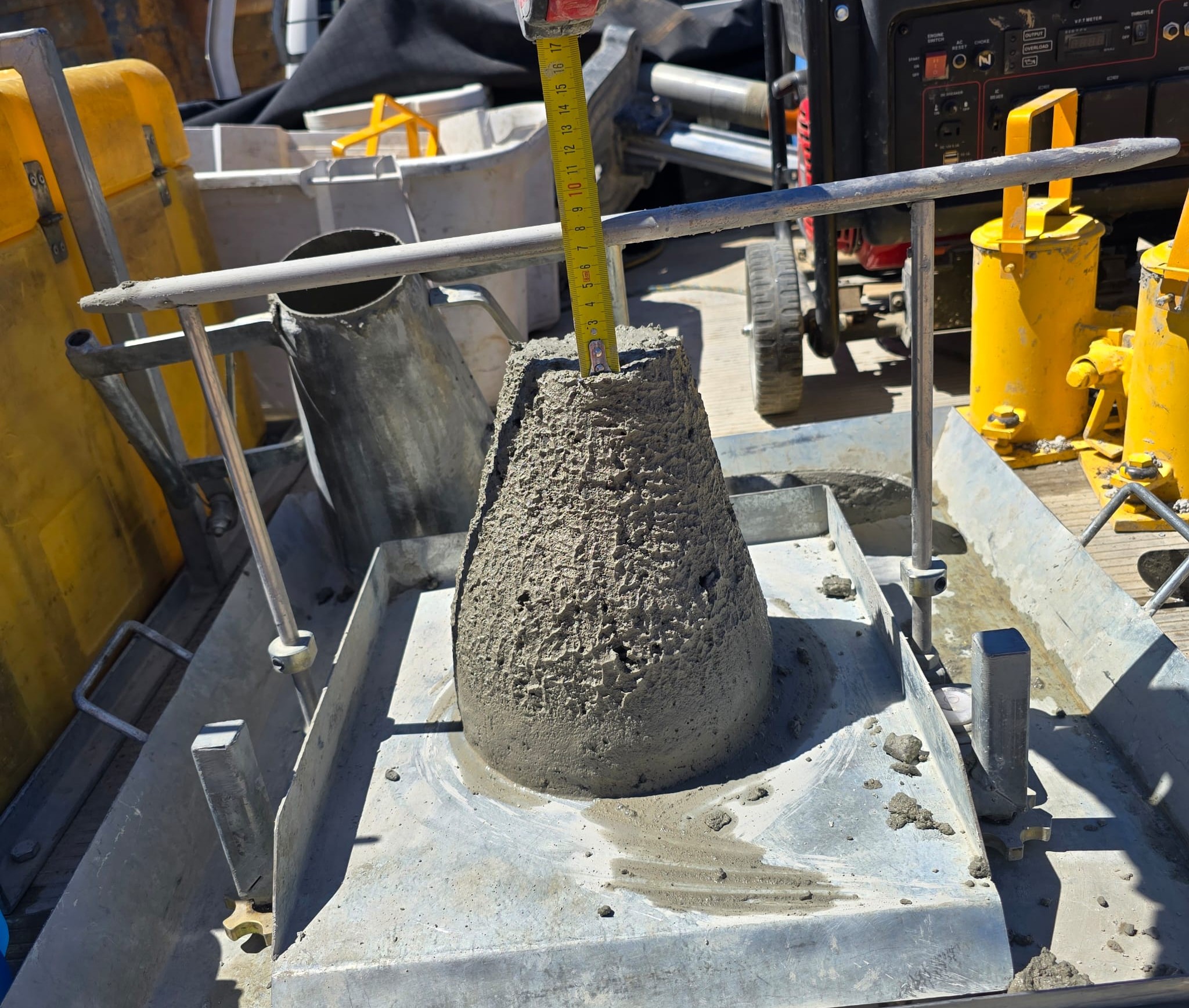
A concrete slump test measures the consistency and workability of fresh concrete in accordance with AS 1012.3.1. The procedure involves filling a standard slump cone with fresh concrete in three equal layers, rodding each layer to consolidate the mix, then lifting the cone vertically. The vertical distance the concrete drops, the "slump", is measured in millimetres.
The slump test is one of the most widely used quality control procedures in the Australian construction industry due to its simplicity, speed, and effectiveness at identifying mix deviations in real time.
Why Slump Testing Matters
Concrete that is too stiff or too fluid can cause significant problems during placement and finishing. Inadequate workability leads to:
- Poor compaction and voids within the structure
- Honeycombing and reduced concrete density
- Reduced structural integrity and durability
- Increased risk of costly rework or non-conformance
Slump testing allows project teams to detect mix deviations early, before concrete is poured, and it protects both quality outcomes and project budgets.
Our Slump Testing Services
Atlas offers slump testing as a standalone service or as part of a broader concrete quality assurance program. Our services include:
- On-site slump testing: performed at the point of delivery or placement across Sydney and greater NSW
- Laboratory slump testing: conducted under controlled conditions at our Sydney facility
- Batch plant audits: monitoring mix consistency at the source
- Companion cylinder sampling: slump tests paired with compressive strength specimens (AS 1012.8.1)
- Test reports and NATA-accredited documentation: compliant records for certifiers, councils, and principal contractors
Typical Slump Classifications
The following table outlines common slump ranges and their typical applications in accordance with Australian practice:
Slump Range (mm)ClassificationTypical Application0 – 25Very LowPrecast elements, dry-cast products25 – 75LowMass concrete, pavements, lightly reinforced sections75 – 150MediumGeneral reinforced concrete, footings, slabs150 – 225HighHeavily reinforced sections, pump-placed concrete> 225Very High / FlowSelf-compacting concrete (refer AS 1012.3.5)Note: Permissible slump values for specific mixes are defined by project specifications, mix design documentation, or the relevant standard. Results outside the specified range are reported as non-conformances.
Applicable Standards
- AS 1012.3.1 – Determination of properties related to the consistency of concrete: Slump test
- AS 1379 – Specification and supply of concrete
- AS 3600 – Concrete structures
Who We Work With
Our slump testing services are used by a broad range of clients across Sydney and NSW, including:
- Civil and structural contractors
- Residential and commercial builders
- Concrete batch plants and suppliers
- Government and infrastructure project teams
- Independent certifiers and construction managers
Request a Slump Test
To arrange on-site or laboratory slump testing, or to discuss your concrete quality assurance requirements, contact the Atlas Engineering and Technology Group testing team. We provide fast turnaround, NATA-accredited reporting, and experienced technicians available across the Sydney metropolitan area and beyond.